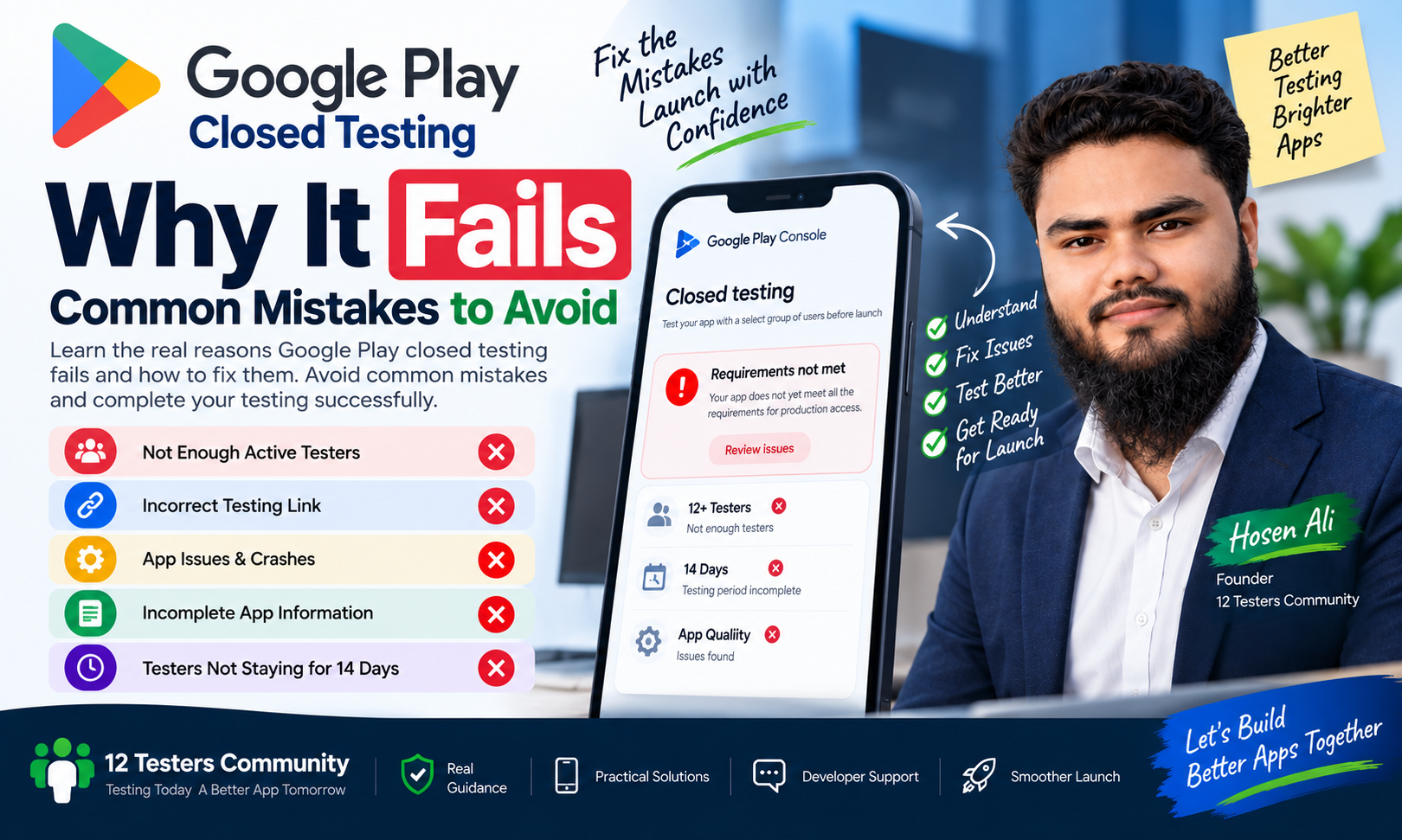
Why Google Play Closed Testing Fails: Common Mistakes to Avoid
Completing a Google Play closed test does not always mean that an app will immediately receive production access.
For applicable new personal developer accounts, Google requires a closed test with at least 12 testers continuously opted in for the preceding 14 days before a developer can apply for production access. However, meeting the minimum tester and time requirement does not guarantee that production access will be granted. Google may determine that an app needs more testing before it is ready for production.
If you have received a message such as “More testing required to access Google Play production,” it is important to understand what may have gone wrong and how to improve your testing process.
What Does “More Testing Required” Mean?
When you apply for production access, Google asks questions about your closed test, your app, and its production readiness.
The closed testing section includes questions about tester engagement, how testers used the app, the feedback you received, and how that feedback was collected. You are also asked to explain changes made to the app based on what you learned during testing and how you determined that the app was ready for production.
This means that closed testing should be treated as a real testing phase—not simply as a countdown of 14 days.
1. Not Enough Testers Remain Continuously Opted In
One of the most important requirements for applicable new personal developer accounts is having at least 12 testers continuously opted in for 14 days before applying for production access.
Starting with exactly 12 testers can also leave very little room for unexpected changes.
For example, if members of your testing group stop participating or are no longer opted in, you should check the status of your testing group before applying for production access.
Best practice
Keep track of your tester group throughout the testing period and make sure the required number remains continuously opted in.
2. Testers Are Not Actually Engaging With the App
Having testers in the testing group is only one part of the process.
Google specifically asks developers to provide information about tester engagement, including whether testers used the available features and whether their usage was similar to what you expect from production users.
A stronger testing process encourages testers to actually explore the app.
Depending on your app, testers might:
- Complete onboarding
- Test login and registration
- Use the main features
- Navigate through different screens
- Test important buttons and forms
- Check notifications
- Test different workflows
- Report crashes or unexpected behavior
- Provide suggestions about the user experience
The testing activities should naturally match what your app actually does.
3. Collecting Tester Feedback Is Not Taken Seriously
Google asks developers to summarize the feedback received during the closed test and explain how the feedback was collected.
Therefore, developers should create a clear way for testers to report issues and suggestions.
You can use:
- A feedback form
- A website
- A messaging channel
- Private feedback through Google Play
Google's Play Console documentation also recommends providing a feedback URL or email address for closed testing.
The important thing is to make it easy for testers to communicate what they experienced.
4. Ignoring Problems Found During Testing
Testing is valuable only when developers use the results to improve the app.
Imagine that testers report:
- A crash during login
- A button that does not work
- A broken navigation flow
- Incorrect information
- A confusing screen
- Performance problems
Simply collecting these reports without investigating them wastes an important part of the testing period.
Before applying for production access, review the feedback and determine whether any meaningful changes should be made to the app.
Google asks developers to describe changes made based on what they learned from the closed test and explain how they determined that the app was ready for production.
5. Treating 14 Days as the Only Goal
One of the biggest mistakes is thinking:
“I have 12 testers and 14 days are complete, so production access must be approved.”
That is not how the process works.
The 12 testers and 14 consecutive days are part of the eligibility criteria for applying for production access. After that, Google evaluates the production access application and asks questions about the testing process and production readiness.
The goal of the testing period should therefore be to make the app genuinely more ready for public users.
6. Not Testing the App's Main Features
A closed test should provide useful information about how the app performs in real-world use.
For example, if your app is a finance app, testers should be able to test relevant financial workflows.
If it is a social app, testers should explore the social features.
If it is a utility app, testers should use the main tools and workflows.
Google recommends using closed testing to identify technical and user experience issues before making an app available more broadly.
The testing plan should therefore be based on the actual purpose of the app.
7. Applying for Production Access Without Reviewing the Test Results
Before applying for production access, take some time to review what happened during the closed test.
Ask yourself:
- Did testers use the main features?
- What feedback did they provide?
- Were any bugs discovered?
- Did we make improvements?
- Are the important user flows working correctly?
- Is the app ready for public users?
- Can we clearly explain what we learned from testing?
These questions can help you prepare more accurate answers in the production access application.
8. Not Understanding the Difference Between Testing and Production
Closed testing is designed for a controlled group of testers.
Production makes the app available to Google Play users in your selected countries or regions.
The purpose of closed testing is to find and address problems before reaching the production stage.
That is why a developer should use the testing period as an opportunity to improve the app rather than simply waiting for the required period to end.
What Should You Do If Google Requests More Testing?
If Google tells you that your app requires more testing, do not assume that the entire process is permanently blocked.
Instead, review your testing process carefully.
Step 1: Review Your Tester Group
Check that the required testers are properly participating and remain continuously opted in as required.
Step 2: Review Tester Engagement
Think about whether testers actually used the app and its important features.
Step 3: Review Feedback
Collect the feedback received during testing and identify recurring problems or useful suggestions.
Step 4: Improve the App
Fix important issues discovered during testing and make appropriate improvements.
Step 5: Continue Testing
Use another closed testing period when Google requires additional testing, while making the testing process more meaningful.
Step 6: Prepare Your Production Access Answers
When you apply again, be prepared to explain:
- How testers were recruited
- How testers engaged with the app
- What feedback you received
- How you collected feedback
- What changes you made
- Why you believe the app is ready for production
These are areas Google explicitly asks about in the production access application.
How to Make Your Closed Testing Process Stronger
A good closed testing process can be simple but structured.
Before testing begins:
- Prepare a stable test release.
- Recruit the required testers.
- Give testers clear instructions.
- Provide a feedback channel.
- Create a list of important features to test.
During testing:
- Encourage testers to explore the app naturally.
- Monitor reported issues.
- Collect useful feedback.
- Investigate crashes and bugs.
- Make improvements when necessary.
Before applying for production:
- Review the tester participation.
- Review the feedback.
- Review the changes made.
- Check the app's main user flows.
- Make sure you can clearly explain what you learned from testing.
Can 12 Testers and 14 Days Guarantee Production Access?
No.
The requirement allows an applicable developer account to become eligible to apply for production access. It does not mean that production access is automatically guaranteed.
Google reviews the production access application and asks questions about the closed test, the app, and production readiness.
This is why developers should focus on quality testing and meaningful feedback, not only on completing the minimum number of days.
Need Help Organizing Your Closed Testing?
Finding testers and coordinating a testing process can be challenging, especially for independent Android developers.
12 Testers Community helps Android developers organize their closed testing process with tester coordination and testing support.
Our goal is to help developers manage the testing workflow, coordinate testers, collect useful feedback, and prepare their apps for the next stage of the Google Play publishing process.
Get Started
If you are preparing an Android app for Google Play closed testing and need help organizing your testing process, visit:
12 Testers Community
https://12testerscommunity.com/
Final Thoughts
Google Play closed testing should not be treated as a simple 14-day requirement.
For applicable new personal developer accounts, the current requirement is at least 12 testers continuously opted in for the preceding 14 days before applying for production access. But developers should also focus on tester engagement, meaningful feedback, app improvements, and production readiness.
If Google requests more testing, use the opportunity to review what happened during the first test, improve the app, involve testers more effectively, and build a stronger testing process.
A successful closed test is not just about completing the required time—it is about learning from real users and making the app better before releasing it publicly.