
Last verified against Google Play Console Help: September 2026.
There is a specific moment in Google Play closed testing where developers discover they do not have twelve testers after all. It usually arrives about ten days in, when someone opens Play Console expecting to see a healthy count and instead sees eight.
The reason is almost never that testers lied. It is that five different situations all get called “having a tester”:
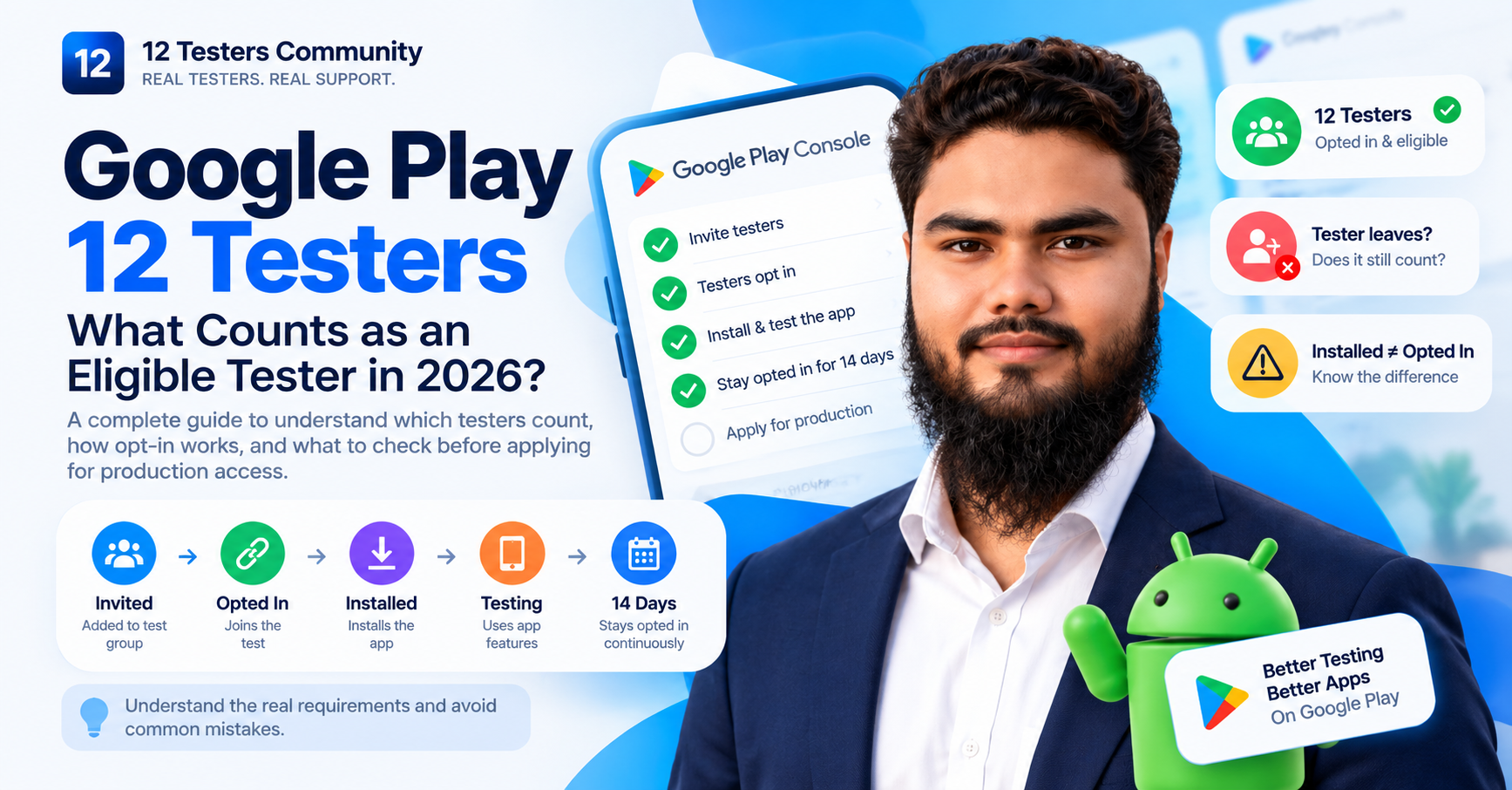
Invited → Opted in → Installed → Testing → Feedback
These are not the same thing, they do not happen automatically in sequence, and only some of them are what Google's requirement is actually about. This article defines each state precisely, shows which ones count towards the 12-tester requirement, and gives you a way to verify your own testers before you apply for production access.
Throughout, we keep one discipline: what Google publishes is labelled as official, and everything else is labelled as practical guidance or our recommendation. Where Google's documentation does not define something — and there are several widely repeated “rules” it does not define — we say so rather than inventing an answer.
Quick Answer: What Counts as a Google Play Tester?
For the 12-tester requirement, a tester counts when three things are true at the same time:
- They are part of your closed test. They are in the closed testing track's tester list, or they are a member of the Google Group attached to that track.
- They completed the opt-in themselves. Google states that each tester needs to opt in using the link. Adding an address to a list is not opting in, and installation is not opting in either.
- They have been opted in continuously for the preceding 14 days at the point you apply for production access.
“At least 12 testers must be opted in to your closed test when you apply for production access, and they must have been opted in continuously for the preceding 14 days.”
— Google Play Console Help, App testing requirements for new personal developer accounts
That is the whole definition, officially. Notice what it does not contain: no minimum number of app opens, no session count, no minutes of use, no feedback quota. Those numbers circulate widely online, and Google does not publish any of them. Everything past the three conditions above is your own testing quality — important, but not the counting rule.
What Is the 12-Testers Requirement?
The requirement is a gate, not a suggestion: for the accounts it covers, production and pre-registration stay disabled until it is satisfied. Google sums it up in three parts.
| Part of the rule | What it means | Status |
|---|---|---|
| A closed test | You must run a closed test before applying to publish to production. Internal testing does not substitute for it | Official requirement |
| 12 testers, minimum | Twelve is the floor, not a target. The count is of testers opted in, not addresses on a list | Official requirement |
| 14 continuous days | Measured per tester, and checked against the 14 days immediately before you apply | Official requirement |
| Applying from the Dashboard | There is no automatic unlock. You answer questions in three sections and Google reviews the submission | Official requirement |
| Real engagement | Google names insufficient tester engagement as a reason it may require continued testing, but publishes no threshold for it | Official, but undefined |
| Recruiting a buffer | Extras absorb normal dropouts. Google publishes no number here — this is a judgement call about your own margin | Our recommendation |
If you want the wider process — setting up the track, briefing testers, and running the fortnight — the complete 14-day guide for 12 testers covers it end to end. This article stays on the narrower question: which people count, and how to tell.
Who Does the 12-Testers Requirement Apply To?
This matters before anything else, because the requirement is narrower than most articles imply. Google's testing-requirements article is written for personal developer accounts created after 13 November 2023. It is not a blanket rule for every developer on Play.
| Your situation | What Google documents | Where to confirm |
|---|---|---|
| Personal account created after 13 November 2023 | This is the group the requirement covers | Dashboard: look for the “Apply for production” prompt |
| Personal account created on or before 13 November 2023 | Google scopes the requirement to accounts created after that date | Dashboard |
| Organization account | The published article is written for personal accounts. Do not assume you are exempt, and do not assume you are covered | Dashboard, plus the help link inside your account |
| A further app on an account that already has production access | No blanket rule is published for this case | Dashboard for that specific app |
Open your Dashboard before doing anything else. It is the authoritative source for your own account and app. If production is already available to you, this article is a quality checklist rather than a gate. If production is disabled and you are being prompted to apply, everything below applies. Our explanation of the 12 testers and 14 days requirement looks at the rule itself in more detail.
Invited vs Opted In vs Installed vs Testing
Five states get described as “being a tester”. Here is what each one actually means, and — the column that matters — whether it satisfies the requirement.
| Status | What it means | Does it satisfy the requirement? |
|---|---|---|
| Invited | You added their email address to the closed testing tester list, or they joined the Google Group attached to it | No. Google's wording is “opted in”, and an invitation is not an opt-in. This is the single most common miscount |
| Opted in | The tester opened the opt-in link themselves and accepted the tester terms. Google states that each tester needs to opt in using the link | Yes — this is the state the requirement is about. Their 14 days start here |
| Installed | The test build is on their device and updates to new test versions | Not documented as a counting rule. Necessary for testing to happen, but Google's requirement is written about testers opted in — so do not treat an install as the thing that gets you to twelve |
| Testing | They are using the app: exercising features, hitting edge cases, noticing friction | Officially relevant, but with no published metric. Engagement is one of two documented reasons Google may require more testing; no daily or weekly threshold is published |
| Feedback submitted | They report what they found, through your channel or as private feedback through Google Play | No minimum number is published. You must summarise feedback when you apply, so it matters — just not as a per-tester count |
Tester status flow showing which stages count towards the 12-tester requirement: invited and installed do not, opted in does What counts: the tester status flow Only the stages marked “counts” are what Google's requirement refers to. The others matter for test quality, not for the count. Invited address added to the list or group Opted in tester opened the link and accepted Installed test build on their device Testing using the app and reporting findings 14 continuous days then you can apply for production access does not count counts not a count no published metric Google's clarification on continuity Testers who opt in, test for fewer than 14 days, and then opt out do not count toward the requirement. If a tester opts out and opts back in later, the 14 days must be consecutive to count toward the minimum requirement of 12 continuous opted-in testers.
Invited and installed are useful stages, but neither is the state Google's requirement is written about. Opted in is.
Why Adding 12 Email Addresses Is Not Enough
Adding testers to a closed test is a list operation. Opting in is a tester action, and only the tester can do it. That gap is the entire reason developers end up short.
What you control:
- Which email addresses are on the tester list, or which Google Group is attached to the track.
- Whether the opt-in link is available at all — Google states that the opt-in link is displayed only when the app status is Published. Apps sitting in “Draft” or “Pending publication” do not show one.
- What you tell testers, and how easy you make it for them to do the one step that counts.
What you cannot do:
- Complete the opt-in on a tester's behalf. Google describes the flow as a link that each tester uses themselves.
- Decide that a tester who replied “installed!” has opted in. Installation and opt-in are separate events.
- Guarantee they stay opted in. Which is why the count is checked when you apply rather than once at the start.
The practical fix: stop counting invitations and start counting opt-ins. Ask every tester to confirm the moment they have completed the opt-in step, and compare those confirmations against the tester figure shown for your closed testing track. Two minutes a day keeps this honest; a single check on day thirteen does not.
How a Tester Opts In to a Closed Test
The sequence below is the tester's side of the process. Steps 1 and 2 are where most of the loss happens — a link that never arrived, or a tester who opened it with a different Google Account than the one you added.
- The tester receives the link from you. Closed-test apps are not searchable on Google Play, so you have to send it. Google states that testers cannot find the app by searching; you share the Play Store URL or the opt-in link.
- They open the opt-in link while signed in to the account you added. If they use a different Google Account, the opt-in applies to that account instead, and the address you added stays unregistered.
- They accept the tester terms. Google describes the tester seeing an explanation of tester responsibilities and a link to opt in, then opting in. This is the step that counts.
- They install the test version. Once opted in, they install from the link, and their app updates to new test versions within a few minutes of you publishing one.
- They stay opted in. Google's guidance to developers is explicit: inform testers that they must remain opted in to the closed test continuously for at least 14 days.
- They continue testing and reporting. Google encourages testers to use as many features as possible and to send feedback through the channel you provide, or privately through Google Play.
Comparison of a tester who is eligible for the 12-tester count and one who is not, based on opt-in status Eligible vs not eligible, at a glance Two testers can look identical from your side of the screen. The difference is whether the opt-in step was completed. Counts towards the 12 Added to the closed testing tester list Opened the opt-in link on the account you added Accepted the tester terms Installed the test build Still opted in today, with an unbroken run Using the app and reporting what they find Their 14 continuous days are counting ! Does not count Added to the tester list, but never opted in Or opted in using a different Google Account Or opted in, then opted out before 14 days Or could not reach the opt-in link at all Installing the app alone does not change this A Google Group member who has not opted in Replace or re-onboard before you apply
The left-hand tester is eligible because the opt-in step was completed and the run is unbroken. Everything on the right is a person who may well believe they are testing your app.
Does Installing the App Make Someone an Eligible Tester?
No — not on its own. Installation is what makes testing possible; it is not what the requirement counts.
What is documented: the requirement is written in terms of testers opted in. Google also documents that testers receive updates for closed versions, and that testers cannot leave public reviews for a test version — neither of which is a statement about the count.
What is not documented: any statement that an installed app forms part of the tester count. You will find guides asserting that the count requires an installed app; that is interpretation, not published policy.
The safe posture is not to choose between the two readings but to satisfy both: get each tester opted in and installed. Installation costs a tester nothing and removes the ambiguity — and a tester without the app cannot test, which is the part that matters for engagement.
Does a Tester Need to Use the App Every Day?
Google's public documentation does not specify a universal daily-open count, a session count, or a minutes-per-day requirement. No number of daily launches, no minimum usage threshold, and no number of feedback messages appear in the testing documentation. If you have read otherwise, you have read someone's operating practice presented as policy.
What Google does say, and it is worth separating cleanly:
| Opt-in continuity | Engagement and feedback | |
|---|---|---|
| Is it a rule? | Yes — 12 opted in, continuously, for the preceding 14 days when you apply | Google recommends clear instructions, using as many features as possible, and a clear feedback channel |
| Is a number attached? | Yes: 12 and 14 | No. No opens, sessions, minutes or message counts are published |
| What it affects | Whether you are eligible to apply at all | Quality of the test — and insufficient engagement is a documented reason Google may require more testing |
| Our recommendation | Tell every tester, in writing, not to leave the test | Ask for real use spread across the fortnight and a short report of anything that looked wrong — not daily attendance |
What Happens If a Tester Opts Out Before 14 Days?
Google answers this directly, and the sentence is worth reading closely:
“Testers who opt in, test for fewer than 14 days, and then opt out do not count toward the requirement. If a tester opts out and opts back in later, the 14 days must be consecutive to count toward the minimum requirement of 12 continuous opted-in testers.”
— Google Play Console Help, FAQ
Two consequences follow. First, that tester does not count — for the simple reason that their run is no longer 14 consecutive days. Second, the rest of your test is not described as being affected: the rule is written per tester, and your eligibility depends on whether 12 testers each have unbroken runs at the moment you apply.
So the practical question after an opt-out is not “has my clock reset?” but “do I still have twelve?” If you recruited a buffer, you may still be fine. If you recruited exactly twelve, you now have eleven and should replace the person before your apply date.
The situations that genuinely put a period at risk — including opt-outs mid-window, confused install-and-opt-in status, and access problems — are set out in what resets or breaks your testing period.
What If a Tester Opts Out and Later Joins Again?
They can rejoin, but the continuity requirement applies to them personally: after opting back in, 14 consecutive days are required again before that tester counts.
Google does not publish a formula for how earlier days are treated, so it is worth being precise about what we know and what we are inferring:
- Documented: the 14 days must be consecutive to count. A broken run does not satisfy a consecutive requirement.
- Documented: the requirement is judged on the 14 days preceding your application.
- Not documented: whether any partial credit exists, or how Google stores individual tester histories. We do not know, and neither does anyone else writing about it.
- Our recommendation: treat a re-joined tester as starting from zero for planning purposes. It is the conservative reading, and it is also the simplest one to track in your own log.
Can I Replace a Tester During the 14-Day Period?
Yes — replacing someone is normal and expected. What matters is that you separate three things that are easy to blur together.
| The tester who left | The replacement | |
|---|---|---|
| Their 14-day run | Broken, per Google's FAQ, because they opted out before 14 days | Starts the moment they complete their own opt-in |
| Everyone else | Unaffected as far as the published rule goes — their runs continue while they stay opted in | Adding them does not disturb existing testers |
| Your apply date | Your count is one lower until the replacement qualifies | You may wait until twelve testers each have 14 unbroken days at the same moment |
| What is NOT documented | Google does not publish a complete replacement or reset algorithm — no formula for how a list change interacts with accumulated days. Anything claiming otherwise is someone's interpretation. The documented anchors are these: 12 opted in, continuously, for the preceding 14 days, checked when you apply |
Practical workflow for handling a tester opt-out during the 14-day closed testing period Handling an opt-out: a practical workflow This is our recommended sequence — not a Google reset algorithm. Google publishes the rule, not the mechanics. 12 testers opted in and counting One tester opts out before reaching 14 days Check the opted-in figure for the closed testing track today Still 12 or more? Apply on schedule. Below 12? Onboard a replacement now. Then confirm every tester's run is still unbroken before you press Apply.
The whole response to an opt-out comes down to one question: how many testers are opted in today, and do twelve of them have unbroken runs?
How Many Testers Should You Recruit?
The official minimum is 12 testers opted in. That number is documented and non-negotiable for the accounts the rule covers.
Our practical advice, clearly labelled as advice: recruit more than the minimum. Testers change phones, lose interest, or simply opt out, and every dropout reduces a count you cannot measure until the day it matters. A small buffer means a dropout costs you margin rather than eligibility.
What we deliberately are not saying: that Google requires 15, 18, 20 or any other number. It does not. Any page stating that Google demands a specific number above twelve is stating something Google does not publish. You will occasionally see “20 testers” in older material — that number belongs to an earlier version of this policy, not to the current requirement.
If recruiting is the bottleneck, the channels and the arithmetic are covered in how to get 12 real testers.
What About Google Groups?
Google supports both email lists and Google Groups for closed-test testers, and groups are convenient when you are recruiting from a community rather than from people you know. There is one extra step that catches people out:
- Group membership comes first. Google states that for closed tests using a Google Group, users must join the group before opting in. Two steps, not one.
- They still have to opt in individually. Membership of the group is not an opt-in. Each person completes the opt-in step using the link.
- They must stay opted in. The same continuity rule applies to group members as to anyone else.
- Group membership can change without your knowledge. People leave groups. If you are relying on a group for your count, check the opted-in figure rather than assuming membership has held.
The mechanics of both approaches, screen by screen, are in how to add testers to a Google Play closed test, and Google documents the group requirement in Set up an open, closed, or internal test.
What About Feedback?
Feedback is where the test earns its keep. It is also the area where invented rules do the most damage, so here is the accurate version.
Documented: Google recommends giving testers clear instructions on how to test and report bugs, telling them what kind of feedback you want, encouraging them to use as many features as possible, and providing a clear feedback channel. It states that you must summarise your testing feedback when applying for production access, and recommends maintaining a record during the test. It also notes that testers can send private feedback directly through Google Play.
Not documented: any required number of written feedback messages, per tester or in total. There is no quota to hit.
So what does a useful feedback report look like? Four ingredients do most of the work:
- “I was trying to…” — the task they had in mind.
- “I expected…” — what they thought would happen.
- “What happened was…” — the actual behaviour, ideally reproducibly.
- “On a [device] running [Android version], app version [x.y.z].” — enough context for you to reproduce it.
A report like that is worth more than twenty messages saying the app is nice. Keep them dated, and by day fourteen your application summary practically writes itself.
What Does “Active Tester” Actually Mean?
“Active tester” and “engaged tester” are terms developers and testing services use constantly. They are useful shorthand — but they are not Google-defined metrics, and you should be suspicious of any page that presents them as though Google scores testers on activity.
A practical description we use, clearly labelled as practical: an active tester has successfully joined the closed test, remains opted in, has the test build installed, and participates meaningfully — using the app and telling you what they find.
Two cautions that follow from that definition:
- Do not turn “active” into a number. Google publishes no daily-open, session, minute or launch threshold. If a service tells you testers must open your app a certain number of times per day, ask which Google page says so.
- Do not dismiss engagement either. Google names insufficient tester engagement as one of two reasons it may require you to continue testing. Engagement is genuinely relevant — it simply has no published threshold, which is why the honest answer is “real, sustained use” rather than “seven opens a week”.
Keeping testers genuinely active across two weeks is a communication problem more than a policy one, and the techniques that work are in how to keep 12 testers opted in for 14 days.
Common Reasons Developers Think They Have 12 Testers — But Don't
In our experience, a short count is almost always one of these eight causes. Each is checkable in minutes.
- They only added email addresses. The list is not the count; opt-in is.
- Testers never completed opt-in. Invited, willing, and forgotten — the most common cause by a distance.
- Testers opted in with a different Google Account from the address you added, so the account you are tracking never registered.
- Some testers opted out part-way through, breaking their own 14-day run without telling you.
- Some testers have been opted in for fewer than 14 days — late joiners are the usual reason your apply date keeps slipping.
- Installation was confused with opt-in. “They installed it” is not “they opted in”.
- The opt-in link was never usable — the app was not yet Published, or the tester's country was outside your release's availability.
- Assumptions replaced checking. Nobody opened Play Console on day twelve to read the actual opted-in figure.
How to Verify Your 12 Testers Before Applying for Production Access
Work through this before you open the application form. It takes about ten minutes and prevents the delay that costs weeks.
- Invitation confirmed — every intended tester is on the closed testing tester list, or in the group, using the Google Account they will opt in with.
- Opt-in confirmed — each tester has personally completed the opt-in step, and you have their confirmation with a date.
- Access confirmed — the app status is Published so the opt-in link exists, the release includes their country, and nobody is stuck at installation.
- Continuity confirmed — the testers you are counting have unbroken runs covering the 14 days before your intended apply date.
- Count confirmed today — the opted-in figure for the closed testing track is at least 12, read from Play Console today rather than remembered.
- Nobody is a “maybe” — if a tester's status is unclear, count them as zero and use your buffer.
- Communication is working — you have a channel that reaches every tester, and you have used it this week.
- Feedback reviewed — reports are logged, and you can summarise themes and the changes you made.
- App issues addressed — no crashes, broken functionality or unreachable screens in the build you will describe.
- Application ready — answers drafted outside the form, with working test credentials in Play Console if reviewers will need to sign in.
12-Testers Verification Checklist
A compact version you can screenshot or copy into your notes.
| Check | What to verify | Status |
|---|---|---|
| On the list | Tester is on the closed testing list or in the attached Google Group | ☐ |
| Opted in | Completed the opt-in step themselves, with the account you added | ☐ |
| Date logged | You recorded the date they opted in, so the 14-day run is verifiable | ☐ |
| Installed | Test build installed, and updating to new test versions | ☐ |
| Still opted in | No opt-out since they joined, confirmed against your log | ☐ |
| Count read today | Play Console shows at least 12 opted-in testers for the closed testing track | ☐ |
| Buffer available | Extra testers ready if someone drops out before you apply | ☐ |
| Feedback summarised | Themes, changes made, and how feedback was collected — ready to paste | ☐ |
| Reviewers unblocked | Working test credentials in Play Console if the app requires sign-in | ☐ |
Frequently Asked Questions
Do I need exactly 12 testers?
No — twelve is the minimum. Google's requirement is “at least 12 testers” opted in continuously for the preceding 14 days, and there is no penalty for having more.
What counts as one tester?
A person who is part of your closed test, has completed the opt-in step themselves, and has been opted in continuously for the preceding 14 days at the point you apply. Invitations and installs are not the count.
Does adding an email address count?
No. Adding an address makes someone able to opt in; it does not opt them in.
Does installing the app count?
Not on its own. Google's requirement is written in terms of testers opted in. Installation is what allows testing to happen, and you should have both — but do not count an install as a tester.
Does opting in count?
Yes. Opt-in is the state the requirement refers to, and the tester's 14-day run starts when they complete it.
Do testers need to open the app every day?
No daily-open rule is published, nor a session, minutes, launch or feedback-message quota. Google does document continuous opt-in, and it names insufficient tester engagement as a reason it may require more testing — so ask for real, spread-out use rather than daily attendance.
What happens if one tester opts out?
Their own run is affected: Google states that testers who opt in, test for fewer than 14 days and then opt out do not count. Your opted-in total drops by one, so check whether you still have twelve and replace them if not.
Can I replace a tester?
Yes. The replacement starts their own 14-day run when they opt in. Google publishes no complete replacement or reset algorithm, so plan conservatively: assume your apply date moves to whenever twelve testers each have 14 unbroken days.
Can I use a Google Group?
Yes. Google supports email lists and Google Groups; for groups there is one extra step, because users must join the group before opting in. Group membership is not an opt-in.
Is feedback mandatory?
No published number of feedback messages is required. However, Google requires you to summarise your testing feedback when you apply, so a test that produces none leaves you with nothing to submit — and insufficient engagement is one of the two documented reasons for being asked to test longer.
Does 14 days guarantee production access?
No. Meeting the criteria makes you eligible to apply. Google reviews each application and emails the account owner with the outcome.
How can I verify my testers?
Keep your own dated log of when each tester confirmed their opt-in, and compare it against the opted-in figure shown for your closed testing track on the day you intend to apply. Play Console does not publish a per-tester opt-in history, so the log is what makes the 14-day run verifiable.
Official Google documentation
- App testing requirements for new personal developer accounts — the requirement, the continuous opt-in FAQ, the production access application, and the reasons continued testing may be required
- Set up an open, closed, or internal test — tester management, opt-in links, Google Group requirements, and feedback collection
- Prepare your app for review — App content declarations and sign-in details for reviewers
Final Checklist Before Applying for Production Access
- At least 12 testers show as opted in for the closed testing track — read today.
- Twelve of them have unbroken runs covering the 14 days before your apply date, according to your log.
- No tester in that twelve is unverified, and a buffer is in place if one goes.
- Testers are still installed, and still able to use the current test build.
- Feedback is summarised into themes with the changes you made because of it.
- The build is stable, App content declarations are clear, and test credentials work.
- Answers are drafted outside the form, ready to submit in one sitting.
Conclusion
The 12-tester requirement is not a headcount of people you have contacted. It is a count of people who have done one specific thing — completed the opt-in — and then kept that status unbroken for fourteen days. Everything that goes wrong with the number comes from collapsing these five states into one word:
- Invited — on your list. Does not count.
- Opted in — completed the step themselves. This is what counts.
- Installed — has the build. Useful, not a counting rule.
- Testing — using the app. Relevant to engagement, which has no published threshold.
- Feedback — telling you what they found. Required as a summary, not as a per-tester quota.
Get those straight and the rest becomes straightforward: log the opt-in date for every tester, check the opted-in figure rather than your list, keep a small buffer, and confirm continuity before you apply rather than discovering a gap afterwards. You cannot shorten the fourteen days, and nothing here guarantees the review — but you can at least be certain that the twelve testers you are counting are real.
12 Testers Community runs Google Play closed tests for indie developers every day: 12 or more real testers on real Android devices, each completing the opt-in themselves, kept opted in for the full 14 consecutive days, with every day of progress tracked live in your dashboard and a written report of their feedback at the end — so the twelve you count are documented, and a dropout is our problem to replace rather than yours to discover. We will not promise you production approval; that decision is Google's, not ours.
See testing plans and pricing · see how the 14 days work · read the service FAQ · or create your campaign. Preparing your application now? Start with how to answer the closed testing questionnaire.
