
Last reviewed against Google Play Console Help: October 2026.
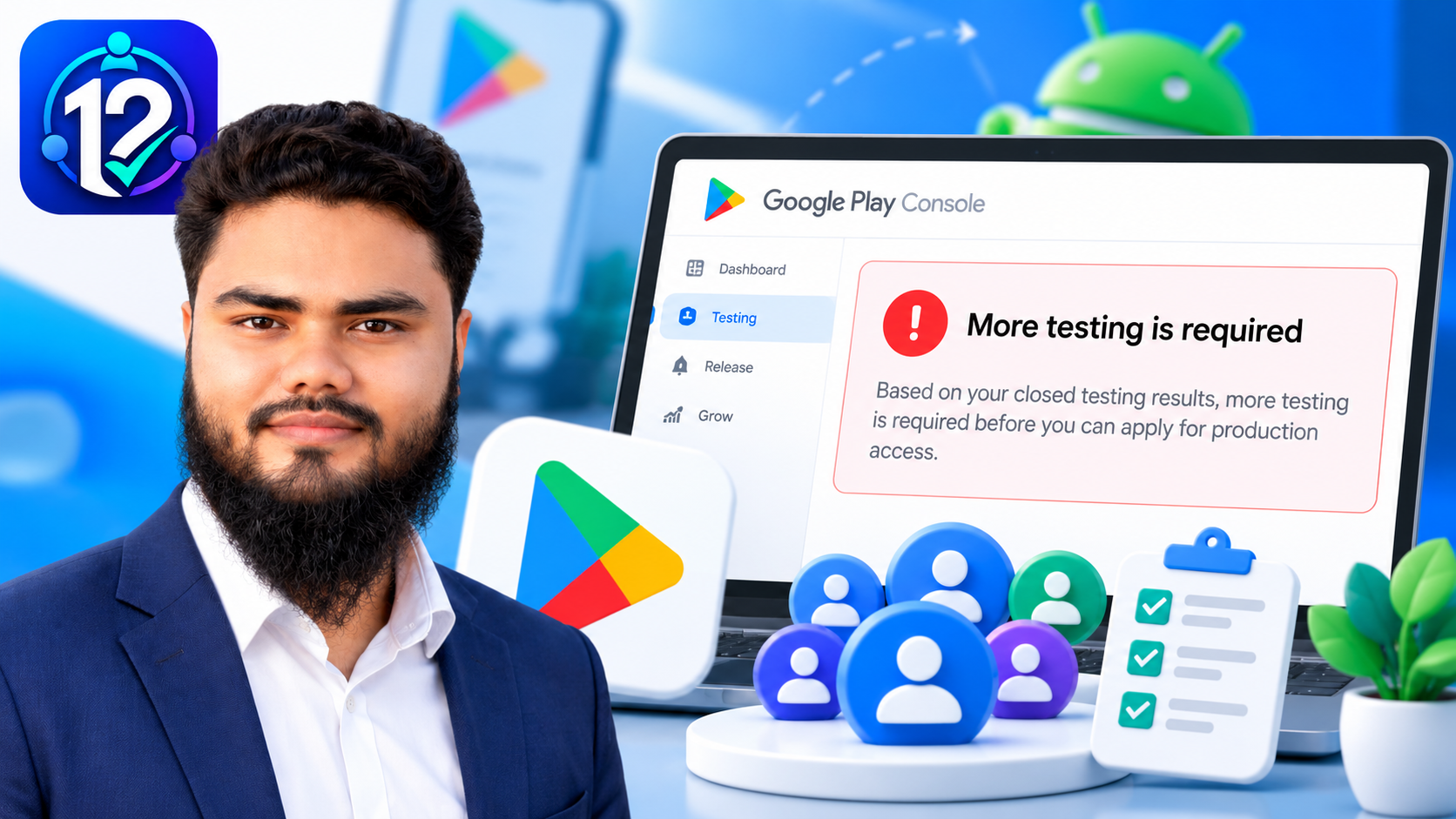
Your closed test finished. At least 12 testers were opted in, the 14 days passed, you filled in the production access questionnaire — and the answer was not an approval. Google told you that more testing is required.
That outcome is frustrating, and it is common enough to deserve a straight explanation. But most of the confusion around it comes from one misunderstanding: the 12-tester, 14-day rule is the gate you pass to be allowed to apply. It is not a promise that the application will be approved.
This article is about that exact moment — the message itself, what Google has actually published about it, what Google has deliberately left unspecified, and how to make the next testing cycle produce the evidence a reviewer is looking for. Everything below is labelled: official Google guidance, what Google does not publish, or practical interpretation based on running closed tests. Where Google has not published a number, this article will not invent one.
Quick answer
- 12 testers opted in continuously for 14 days is the published eligibility requirement for affected new personal developer accounts. Meeting it lets you apply for production access.
- It does not guarantee approval. Google reviews each application, and its official testing requirements state that if an app "requires additional testing," you may need to continue running your closed test.
- Google's published reasons for requiring continued testing are documented: fewer than 12 opted-in testers, or insufficient tester engagement during the testing period.
- The application asks about quality, not only quantity — tester engagement, whether testers used the available features, the feedback you received, what you changed, and how you decided the app was ready.
- Google publishes no universal daily-use threshold. No required sessions, minutes, opens, daily-active-user percentage or install count appears in the official documentation.
- The productive response is a better-evidenced next test: broader feature coverage, genuine feedback, documented fixes, and a production-readiness story you can explain in plain language.
What does "more testing is required" mean?
The direct answer: Google reviewed your closed test and the application that followed it, and concluded that the evidence on record was not yet strong enough to justify releasing the app to everyone. It is asking you to keep testing and apply again.
Under the hood, this maps to one sentence in Google's published testing requirements: "If your app requires additional testing, you may need to continue running your closed test. Reasons for required continued testing include having fewer than 12 opted-in testers or insufficient tester engagement during the testing period." That is official, and it is effectively all Google publishes about this outcome. Notice that neither documented reason carries a number attached to it.
Where you encounter it varies, and so does the wording. Google's Help Center never uses the phrase "more testing is required" — its published language is additional testing and continue running your closed test. The messages developers actually report receiving are phrased differently depending on the surface: a decision email headed "More testing required to access Google Play production", a Play Console notice reading "Your app requires more testing to access Google Play production," or a variant such as "Your app isn't ready for Google Play production yet." An email notification to the account owner is part of the published process; the text inside it is not.
Reported, not published
Google does not publish the text of the decision email. The headings above, and the reasons developers quote from that email — testers not being engaged with the app during the closed test, and testing best practices not being followed, which may include gathering and acting on user feedback through updates — come from developers reproducing what they received. They are consistent with Google's published policy, but they are not official documentation. Treat the exact wording as reported, not guaranteed.
The substance is the same on every surface: the requirement was met as a formality, but the review was not satisfied that the app has been genuinely exercised by real users.
It is worth being equally clear about what the message does not mean:
- It does not automatically mean your app is broken or has a technical defect.
- It does not mean you failed because you had 12 testers instead of 20.
- It does not mean uploading an update invalidated anything, and it does not mean you must start from zero.
- It does not mean there is a published daily session count that you missed.
- It does not mean that buying more testers is the fix.
What it does mean is that the quality of the evidence matters as much as its existence. A closed test where 12 accounts stayed opted in but barely opened the app tells a reviewer almost nothing about whether the app is ready for production.
Does 12 testers for 14 days guarantee production access?
No — and this is the single most important distinction in the whole process.
Google's documented rule is that at least 12 testers must be opted in to your closed test when you apply for production access, and they must have been opted in continuously for the preceding 14 days. Personal developer accounts created after 13 November 2023 are the accounts this applies to. Google's own words on continuity are precise: "Testers who opt in, test for fewer than 14 days, and then opt out do not count toward the requirement. If a tester opts out and opts back in later, the 14 days must be consecutive to count toward the minimum requirement of 12 continuous opted-in testers."
Read that carefully, because of what it does not say. It does not say "12 testers and 14 days, and production access will be granted". It says those numbers are what you need before you are permitted to ask. Google then reviews the request — the tester engagement, the tester feedback, and the case you make for your app's readiness — and decides.
It is also worth confirming the rule applies to you at all: it is a requirement for personal developer accounts created after 13 November 2023. If your app is under an organisation account, or the personal account predates that date, the closed testing gate described here does not apply. Do not assume a rule you have read about is a rule you are subject to.
Think of it as eligibility versus approval:
| Eligibility (published, countable) | Approval (reviewed, judged) |
|---|---|
| At least 12 testers opted in to your closed test | Whether those testers genuinely engaged with the app |
| Opted in continuously for the preceding 14 days | Whether the testing produced useful, documented feedback |
| You can apply for production access | Whether Google accepts that the app is ready for production |
The left column is a checkbox. The right column is a judgement, made by a person or a review process, from the evidence you supplied. That is why two developers can both run "12 testers for 14 days" and get different answers.
None of this is hidden or contradictory. Google states plainly that the requirement exists to make sure an app has been tested by real users before a wider release, and that meeting it makes you eligible to apply. The disappointment comes from reading the requirement as a receipt rather than a starting gun. For the full mechanics of the requirement itself, see 12 testers and 14 days explained.
What does Google actually look at during the closed test?
Google does not publish a scoring rubric, but it publishes more than most developers realise. The following is all official guidance, drawn from Google's testing requirements and closed testing documentation.
What Google asks developers to do during the test:
- Give testers clear testing instructions — what to install, what to try, what you want to learn.
- Tell testers what feedback you want rather than waiting for whatever they volunteer.
- Encourage testers to use as many features as possible, so feedback covers the whole app rather than the first screen.
- Provide a clear feedback channel — one place where issues and impressions actually reach you.
- Inform testers that they must remain opted in continuously for at least 14 days, and keep them informed so they do not drop out.
- Summarise the testing feedback when you apply for production access.
What the production access application asks about: how easy it was to recruit testers; how engaged those testers were; whether testers used all the available features; whether tester usage matched the behaviour you would expect from production users; the feedback you received; how you collected it; the changes you made as a result; and how you determined the app was ready for production.
Notice that only one of those questions is about counting. The rest are about evidence. This is the part developers underestimate: the application is where your testing has to become a story — we asked testers to do this, they used these features, they reported this, we fixed that, and here is why we believe the app is ready.
If that story is thin, "more testing is required" is a likely outcome even though the 12 and the 14 were both satisfied. Our guide to answering the closed testing questionnaire covers the questions in detail, and what to record during your 14-day test covers the notes to keep while the test runs.
What Google does not publicly specify
This section exists because the most damaging advice in this niche is a confident number. It is worth stating plainly what does not appear anywhere in Google's published documentation:
| Not published by Google | Why developers assume it exists |
|---|---|
| A required number of app opens per tester | Blog posts and services quote figures as if they were policy |
| A required number of sessions per day, or minutes per day | It would make an unpredictable review feel controllable |
| A required daily-active-user percentage | It sounds like the kind of metric Google would use internally |
| A minimum install count beyond the tester requirement | Installs are easy to count, so people assume they are the measure |
| A single published "engagement score" | "Engagement" is a real word in Google's documentation, so a number feels implied |
| A fixed number of extra days after a "more testing" decision | Developers want a definite finish line to work towards |
| A crash-rate or ANR ceiling used for production access | Android vitals publishes quality thresholds, and they get quoted as approval gates |
| A reset rule or cooldown period after being asked for more testing | Developers assume the 14-day clock restarts, and plan around it |
| A required number of releases or updates during testing | Specific counts circulate in guides as if they were policy |
| A minimum number of feedback entries, or a minimum answer length | Precision makes an unpredictable review feel controllable |
| A requirement to test on multiple device models, IPs or locations | It sounds like a reasonable anti-fraud measure, so it gets stated as fact |
Google writes about tester engagement — it says explicitly that insufficient tester engagement is a reason it may require continued testing. What it does not do is publish a threshold, a formula, or a score. That distinction matters: the absence of a published number is not a gap in your knowledge, it is the actual state of the documentation.
It is worth naming the specifics that circulate, because they are confident and wrong. Ranking articles in this niche have quoted requirements such as a set number of daily active devices, a range of minutes per session, dwell time minimums, an engagement index, a precise number of timestamped feedback entries, and crash and ANR percentages presented as production access gates. Those crash figures are real numbers, but they belong to Android vitals quality thresholds for store behaviour — not to the production access decision. The engagement index, the dwell time rule and the daily-device ranges are invented. None of them appears in Google's documentation.
So treat any article, video or service that states a specific daily requirement as unverified unless it links to an official Google page that says so. In practice, "use the app every day for 14 days" and "give testers several minutes of real use" are strategies that reliably produce good evidence — not rules you can be failed for missing. Framed that way they are genuinely useful. Framed as policy, they send developers hunting for a number that does not exist instead of improving the test.
Why can a developer have 12 testers and still need more testing?
Here is the practical interpretation, based on the reasons Google documents and the way real closed tests tend to go. None of these is a published Google rule; each is a pattern that produces weak evidence.
1. Testers were opted in, but engagement was weak. Twelve accounts can be opted in for 14 days with almost no app usage behind them. Google names insufficient tester engagement as a documented reason for requiring continued testing, so this is the single most common explanation.
2. Testers never explored the important features. If everyone used only the login screen and the home tab, the test never exercised the parts of the app that matter — and the application question about whether testers used all available features has no good answer.
3. Feedback was minimal or undocumented. Nothing was written down, or it was spread across chat messages that no longer exist. When you are asked to summarise your testing feedback, there is little to summarise.
4. The app was not tested realistically. Testers tapped through once on day one and never returned to normal use. Google's documentation explicitly asks whether tester usage matched what you would expect from production users.
5. You could not clearly explain what was learned. The test ran, but the developer cannot describe what changed because of it. Readiness is a question with an expected answer, and "nothing needed changing" is a difficult one to support.
6. The app changed significantly during the test. Large changes mid-test mean much of the early testing no longer describes the app you are asking to release. That is not a disqualification, but it weakens the case that the current build has been validated.
7. Google simply determined that additional testing was necessary. The published documentation leaves room for this, and no developer is entitled to the reasoning behind a given decision. When this happens, the response is the same: strengthen the evidence and apply again.
Here is the same set as a working table you can compare against your own test. Everything in this table is practical interpretation, not official policy:
| Issue in your test | What it means | What to do next |
|---|---|---|
| 12 testers, weak engagement | The numerical threshold alone may not tell the whole story | Plan specific tasks so usage is real and produces records |
| Little or no feedback | Harder to demonstrate what the test taught you | Use a structured feedback process with a single channel |
| Key features never explored | Coverage is thin where it matters most | Give testers feature-specific instructions and a checklist |
| No clear testing findings | The production-readiness story is weak | Record issues, fixes and results as they happen |
| Testers dropped out | Continuity of opt-in breaks, and the count can fall below the requirement | Recruit a buffer and check opt-in status regularly |
| Big changes mid-test | Earlier testing no longer describes the current build | Re-test the changed areas and note what was validated when |
If the tester count itself was the problem, the published requirement is the place to start — the article on 12 testers not counting covers the states that break it, and what resets or breaks your testing period covers continuity in detail.
What should you do if Google requests more testing?
A calm, ordered response. Not everything below will apply to your situation, but the order matters — diagnosis before rebuilding.
- Read the response carefully. The decision arrives in Play Console and by email to the account owner. Note which part of the process it refers to and what, if anything, it asks you to do.
- Keep your testing track and tester setup organised. Do not tear down the closed testing track or delete testers out of frustration. Continuity is what the requirement measures.
- Review tester participation honestly. For each tester, ask: did they opt in, did they install, and is there any sign they used the app? Be blunt. This is the question you will also have to answer in the next application.
- Test the important features systematically. Build a short list of the flows that matter most — onboarding, the core task, payments or account screens, settings — and make sure each one is exercised.
- Collect meaningful feedback. Ask specific questions rather than "any thoughts?". Concrete prompts produce concrete answers you can act on and quote.
- Fix the important issues. Prioritise what testers actually hit. A short list of real fixes is far more valuable than a long list of cosmetic tweaks.
- Document what changed. Keep a simple record: what was reported, what you changed, what you verified afterwards. This becomes the summary Google asks for.
- Run the test long enough to gather useful evidence. Google's policy wording does not attach a duration to continued testing, but the decision emails developers report receiving often say to continue closed testing "for an additional 14 days" — that is what many developers have been told, not a published rule. Treat it as a floor for a sensible next cycle rather than a guaranteed finish line.
- Reassess production readiness. Ask the question the application will ask: is this app ready for real users, and can I explain why in a few sentences?
- Reapply when the evidence supports it. You can apply once the published requirement is satisfied again. Applying with a stronger record is the goal — not applying faster.
Two things not to do: do not restart your test from scratch without a reason, and do not assume you need exactly one more fixed period. Neither is supported by Google's documentation.
How to make your next closed test stronger
This is practical guidance, and it is where the outcome is usually decided. All of it is within your control before the test even begins.
- Write tester instructions once, properly. Link, install steps, what to test, when the test ends, and how to report. Assume nobody will ask you a follow-up question.
- Ship a feature checklist. A short list of screens and flows with a checkbox each converts vague usage into verifiable coverage.
- Write the feedback questions in advance. "Did onboarding make sense?", "What did you expect to happen when you tapped X?", "What almost stopped you from finishing?"
- Define one bug-reporting process. A single channel — a form, a shared doc, a group thread — with what to include: what happened, what was expected, which device.
- Give testers realistic user flows. Ask them to complete a real task end to end, on different devices, the way a genuine user would.
- Communicate in one place. A brief welcome, a mid-test nudge, and a closing message are usually enough to keep people engaged without nagging.
- Track opt-in continuity. Check Play Console periodically so a dropout is a small correction rather than a lost cycle, and recruit a buffer for exactly this reason.
- Record feedback as it arrives. Notes taken on the day are worth far more than a reconstruction two weeks later.
- Document fixes and their verification. "Reported on day 3, fixed on day 5, confirmed on day 7" is exactly the kind of evidence the application rewards.
- Compare test behaviour with expected production behaviour. Google asks this directly, so form a view on it while the test is running.
For a fuller version of this process, the complete 14-day guide for 12 testers and the closed testing checklist cover the timetable and the tracking.
What should testers actually do during the test?
These are practical testing recommendations. Google publishes no mandated daily routine, and no part of this list is a rule you can be penalised for missing — but a test where testers do these things produces the evidence a reviewer is looking for.
- Install the app and confirm they are actually opted in.
- Complete onboarding the way a first-time user would, including the confusing parts.
- Explore core features — not just the first screen.
- Test important workflows end to end, including anything involving accounts, data or payments.
- Try different screens and states, including empty states, error states and settings.
- Test on their own device at their own pace, so usage reflects real conditions.
- Report bugs with enough detail to reproduce them.
- Give useful feedback, including confusing moments and expectations that were not met.
- Test updates when asked, and note whether anything they reported got better.
What matters is not a daily ritual. It is that a tester returns to the app more than once, uses more than one feature, and tells you something you did not already know.
One warning, because it is the most persistent myth in this topic. You will find advice — including community posts and even community-authored pages hosted on Google's support domain — stating that testers must use the app daily to count. That is not what Google publishes. Google's requirement is continuous opt-in, defined above, and there is no daily-usage rule anywhere in its documentation. A community guide is not policy. If a tester misses a day and stays opted in, they still count. For the full breakdown of that myth, see whether testers need to use your app every day.
Should you get more than 12 testers?
Google's requirement is at least 12 testers opted in continuously for 14 days. It does not require more than 12, and having more than 12 does not guarantee anything.
That said, a small buffer is a sensible practical strategy, and it is worth being explicit that this is a strategy rather than a rule. Real testers become unavailable: a phone breaks, someone uninstalls, someone simply drifts away and the opt-in lapses. Because the requirement counts testers who have been opted in continuously, losing one near the end of the period can pull you below the line and cost you time.
Many developers therefore recruit 15 or 16 so that a dropout is survivable without restarting anything. Choosing to do this is a judgement call about your own recruiting pipeline — not something Google asks for. What is genuinely valuable is knowing which testers actually count before you rely on the number.
Can a testing service prevent "more testing required"?
Honest answer: no service can guarantee Google's production access decision, and any service that says otherwise is selling you something it cannot deliver. The decision is Google's, it is made on the evidence of your test, and it is not for sale.
What a professional testing service can legitimately do is remove the operational reasons a test fails to produce evidence:
- Recruitment and coordination — enough real people with Android devices, onboarded with instructions and reminders, and monitored so they stay opted in across the period.
- Testing structure — a plan that covers the features you care about instead of whatever a tester happens to open first.
- Real-device testing — genuine usage on real hardware rather than a single test device.
- Feedback collection — a channel and a format that produces notes you can act on and summarise, rather than scattered chat messages.
- Organised records — something to draw on when you complete the application.
What it cannot do is decide the outcome, manufacture engagement you did not earn, or make an app ready that is not ready. Keep that boundary in mind when comparing providers — including us.
How 12 Testers Community can help
If your problem was never the count — if the 12 were opted in, the 14 days passed, and the answer was still "more testing is required" — then what the next cycle needs is evidence, not just headcount. That is what our testing support is built around.
- 12+ testers, so the published tester requirement is covered with a buffer for dropouts.
- 14-day closed testing support, with testers kept opted in continuously across the period.
- Real Android devices rather than emulators, tested the way real users would use the app.
- Practical, structured testing — testers who explore your features and report what they find, not accounts that stay opted in and do nothing.
- Organised testing records you can summarise when you complete the application.
- Developer support while the test runs and while you prepare to reapply.
- Pricing that starts at $14.99, so organising a proper test does not require a budget decision.
We are not affiliated with Google, we are not an official Google service, and we do not promise production access — no one can. What we can do is make sure the testing behind your next application is real, continuous and documented, so weak engagement stops being the story of your test. If you do not already have a reliable group of testers, 12 Testers Community can help organise the testing process so you can focus on improving your app.
Frequently asked questions
Why does Google say more testing is required?
Google's published testing requirements state that continued testing may be required, and document two reasons: fewer than 12 opted-in testers, or insufficient tester engagement during the testing period. In practice, a test can also produce weak results when testers used the app only briefly, never explored the important features, or produced little documented feedback — so the application has little evidence behind it.
Does 12 testers for 14 days guarantee production access?
No. At least 12 testers opted in continuously for the preceding 14 days is the published requirement you must meet to apply for production access. It makes you eligible; Google then reviews the application — including tester engagement, feature usage and feedback — and decides. Google describes this as being eligible to apply and states that an app requiring additional testing may need to continue its closed test, which makes approval clearly a separate step rather than a consequence of the numbers.
What does Google mean by tester engagement?
Broadly, that the testers you recruited actually used your app rather than simply staying opted in. Google's guidance asks developers to encourage testers to use as many features as possible, to give clear instructions and a clear feedback channel, and to summarise the testing feedback when applying. Its production access application asks how engaged testers were and whether their usage matched expected production behaviour. Google does not publish a numeric definition or threshold for engagement.
Do testers have to use the app every day?
No. Google publishes no requirement to open the app daily, and no minimum number of opens, sessions or minutes. What is required is that at least 12 testers remain opted in continuously for the preceding 14 days. Daily use is a practical technique that reliably produces good evidence — treating it as a rule is a common mistake. See do testers need to use your app every day.
Is there a minimum number of sessions Google requires?
Google does not publish a minimum number of sessions, minutes, opens, or a daily-active-user percentage. Any specific figure you see quoted is not official policy unless it links to a Google page that states it. The published requirement is about how many testers are opted in and how long they stay opted in — not about a session count.
How many days of additional testing are required?
Google does not publish a fixed number of extra days after requiring more testing. The sensible approach is to keep testing until you can produce a testing record you can stand behind — broader feature coverage, real feedback, documented fixes — and then apply again once the published 12-tester, 14-day requirement is satisfied.
Should I get more than 12 testers?
Not because Google requires it — Google requires at least 12. A buffer (15 or 16, for example) is a practical strategy because real testers drop out, and losing one near the end of the period can break the continuity the requirement measures. More testers does not guarantee approval, and more testers with weak engagement is not an improvement.
What should testers do during a closed test?
Install the app, complete onboarding, explore the core features, test the workflows that matter end to end, try different screens and states, and report bugs and feedback with enough detail to act on. These are practical recommendations; Google does not mandate a daily routine.
Can a testing service guarantee production access?
No. Production access is Google's decision, based on your test and your application. A service can help with recruitment, coordination, structure, real-device testing, feedback collection and record-keeping — all of which improve the evidence behind your application — but no provider can guarantee the outcome, and you should be sceptical of any that claims to.
What should I improve before applying again?
Feature coverage first: make sure testers genuinely exercise the flows that matter. Then feedback: collect it in a structured way you can summarise. Then documentation: record what was reported, what you changed, and how you verified the change. Finally, the readiness case: be able to explain in a few sentences why the app is ready for production. The checklist below turns this into a list.
Final checklist before reapplying for production access
A practical checklist, not a set of Google requirements — and completing it does not guarantee approval.
Before you reapply
- ☐ At least 12 testers were opted in continuously for the required period
- ☐ Testers received clear testing instructions
- ☐ Core features were actually tested, not just opened
- ☐ Meaningful feedback was collected in a single channel
- ☐ Important bugs were reviewed and fixed
- ☐ Testing results and fixes were documented as they happened
- ☐ Changes made after testing are understood and verified
- ☐ Production readiness can be explained clearly in a few sentences
- ☐ You can accurately describe tester engagement, including its weak points
Final takeaway
"More testing is required" is not a verdict on your app and it is not a puzzle with a hidden answer. It means the published requirement was met as a formality while the review was not convinced by the evidence of genuine testing. The 12-tester, 14-day rule is what makes you eligible to apply; Google's own documentation keeps approval as a separate step, and describes asking developers to continue testing when an app needs it.
The fix is not more testers, more days, or a number copied from a blog post. It is a better-evidenced test: real people, actually using the features that matter, reporting things you can act on, with a record you can summarise honestly when you apply. Do that, and the next application argues its own case. For the broader picture of how developers get this wrong, why production access is still refused after 14 days is the deeper read; for the recruitment side, see how to get 12 testers.
About this guide. 12 Testers Community organises Google Play closed testing for indie Android developers. This article reflects that experience; it is not affiliated with Google, and nothing here guarantees a production-access decision. Google's requirements, quoted above, are documented in App testing requirements for new personal developer accounts, with setup detail in Set up an open, closed, or internal test and release guidance in Prepare and roll out a release.
Want the next test to stand up to review?
12 Testers Community helps Android developers organise Google Play closed testing with real testers on real Android devices and structured testing support — opted in and kept opted in across the required period, exploring your app and reporting what they find.
Start your closed test or read the plans and pricing first. We do not promise Google approval — no one can.
